

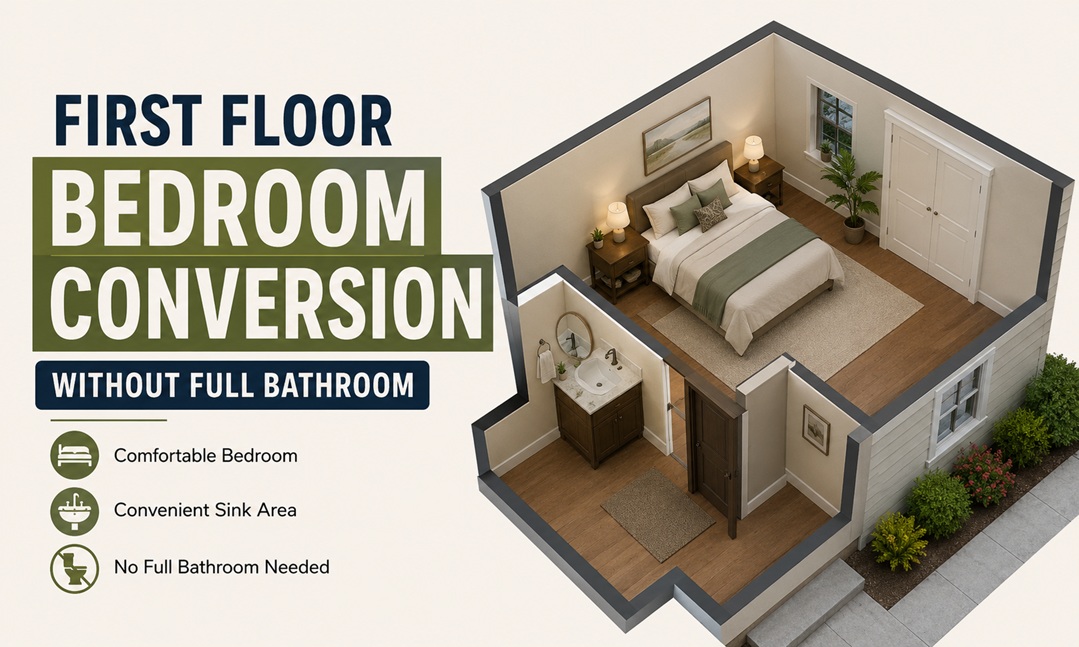
A first floor room can legally count as a bedroom without a full bathroom in most U.S. jurisdictions, as long as it meets basic code requirements: a closet (in many areas), an egress window or door for emergency exit, minimum square footage, and a ceiling height of at least seven feet. A full bathroom is a comfort upgrade, not a legal requirement for bedroom status, though it does affect resale value and day-to-day convenience.
A Real Case: Turning a Home Office Into a Ground Floor Bedroom
Picture a typical scenario: a couple needs a downstairs bedroom for an aging parent or a family member with mobility limitations. They have a first floor home office — decent size, a window, a closet already built in from when the house was framed as a four-bedroom. The nearest bathroom is a half-bath down the hall, not attached to the room.
The conversion itself ends up being mostly cosmetic: removing the desk setup, confirming the closet meets local code (some areas require a minimum closet size for a room to officially count as a bedroom), and checking the window meets egress requirements — wide and low enough for someone to climb through in an emergency, since fire code treats this as a real safety issue, not a technicality.
What they don’t do is add a full bathroom, mainly because of cost and the plumbing work required to route water lines to a room that wasn’t built for it. The half-bath down the hall ends up being functional enough for daily use.
Lessons Learned From This Kind of Conversion
The closet requirement catches people off guard more than anything else. In many jurisdictions, a room without a closet can’t be officially listed as a bedroom on paper, even if it’s used as one day to day — this matters at resale time, when listing details are checked against permits and county records. If the room doesn’t have a closet, adding even a basic one is often worth the modest cost just to make the bedroom designation official.
Egress windows are the other detail people underestimate. A small decorative window might look fine but fail to meet the minimum opening size required for emergency exit, especially in finished basements or smaller first-floor rooms originally built as offices or dens. This is genuinely a safety requirement, not bureaucratic box-checking — it’s the difference between an escape route and a dead end in a fire.
The lack of a full bathroom rarely blocks the conversion itself, but it does change how the room functions in daily life, especially for older adults or anyone with mobility needs. A half-bath two rooms away is a very different experience than an attached full bath at 2 a.m.
Appraisers and buyers also weigh things differently than building code does. Code might allow a bedroom without an attached bath, but resale value often reflects whether there’s at least a bathroom on the same floor, even if it’s not directly attached to the bedroom itself.
Recommendations
If the goal is making a room usable as a bedroom soon — for an aging parent, a returning adult child, or simply rearranging the household — focus first on the closet and egress window requirements, since those are the two most likely to require actual construction work rather than just rearranging furniture.
If a full bathroom addition is being considered, weigh it against a simpler alternative first: adding or upgrading a half-bath on the same floor, if one doesn’t already exist nearby. A half-bath is dramatically cheaper than a full bathroom addition, since it skips the shower or tub plumbing, and it solves the “no bathroom on this floor at all” problem that affects both daily convenience and resale value.
A full ensuite bathroom addition makes the most sense when the room is intended for long-term, frequent use by someone with limited mobility, where walking down a hallway at night is a genuine safety concern rather than a minor inconvenience. In that case, the cost of plumbing work is usually justified by both function and the home’s long-term value, since a true first-floor primary suite is a feature buyers actively look for.
For most other situations, a first floor bedroom conversion without a full bathroom is a perfectly legitimate, code-compliant option — it just helps to know upfront which details (closet, egress, ceiling height) actually matter for the room to count as a bedroom on paper, and which ones (the attached bathroom) are purely about comfort and resale polish.
