

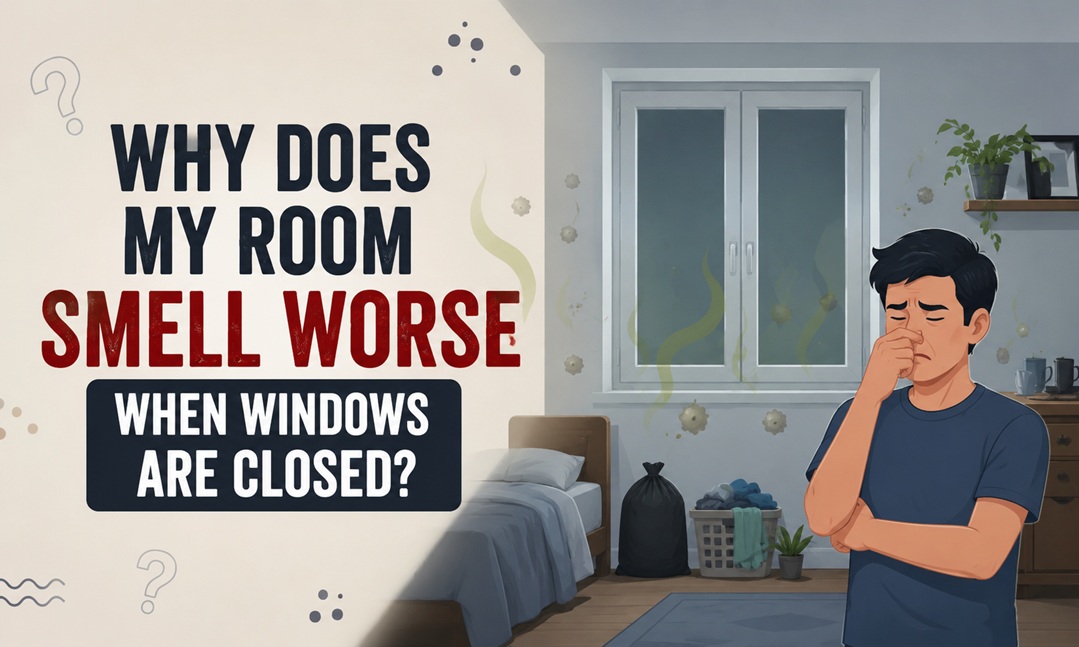
A room smells worse with the windows closed because indoor air pollutants — moisture, mould spores, body odour, pet dander, off-gassing from furniture — have nowhere to go. Fresh air constantly dilutes these compounds when windows are open. Seal the room and concentrations build until you notice the smell. The source is almost always in the room itself.
This is not just about comfort. Consistently poor indoor air quality affects sleep quality, concentration, and respiratory health, particularly for people with asthma or allergies.
What Is Actually In the Air
Several things contribute to bad room smell when ventilation is reduced.
Moisture and mould: The most common culprit. Sleeping in a room adds significant moisture to the air through breathing alone — roughly half a litre overnight for a single person. Without ventilation, that moisture settles on cold surfaces like external walls and window frames. Mould follows. The smell is distinctive — earthy and stale.
Body odour compounds: Skin cells, sweat, and the compounds they break down into linger in soft furnishings like mattresses, pillows, and curtains. These are always present but masked when fresh air circulates.
Off-gassing: Newer furniture, carpets, mattresses, and paint emit volatile organic compounds (VOCs) as they age. These are odourless in small quantities with ventilation, but in a sealed room they accumulate and produce a distinctive chemical or “new” smell that many people find uncomfortable.
Pets: Pet dander and the compounds in pet hair and saliva are persistent. They settle into carpet and upholstery and are very effectively masked by outdoor air — and very effectively concentrated without it.
How to Actually Fix It
Open the windows when you can, even briefly. Ten minutes of cross-ventilation significantly reduces indoor pollutant concentrations.
If opening windows is not practical — because of noise, pollution, temperature, or security — address the sources directly.
For moisture: use a dehumidifier in rooms that feel damp. Target 40–50% relative humidity. In the UK and many parts of Australia and Canada, indoor humidity often exceeds this in autumn and winter. Bathroom and kitchen extractor fans matter more than most people realise — run them for at least 15 minutes after cooking or showering.
For mould: check behind furniture pushed against external walls, under mattresses, and around window frames. Small patches can be treated with diluted white vinegar or mould-specific sprays. Persistent or large patches need professional remediation.
For pet odour and body odour: wash bedding weekly, vacuum soft furnishings regularly with a HEPA filter vacuum, and wash or air curtains every few months.
For VOC off-gassing: air new furniture outdoors for 24 hours before bringing it inside if possible. Place air-purifying plants in the room — peace lilies and spider plants are both well-evidenced for absorbing some VOCs.
Local Considerations Worth Knowing
In humid climates — coastal Australia, much of the UK during winter, and wet-season regions of Canada — moisture management is particularly important. Sealed rooms in these climates accumulate moisture faster than in drier areas.
Older housing stock in the UK, and in parts of Eastern Canada and Australia, often has inadequate wall and ceiling insulation. Cold surfaces cause condensation, which accelerates mould growth even when the room is used normally.
FAQ
Will an air purifier fix the smell?
It helps with airborne particles and some VOCs, but it does not address moisture or mould at the source. Use it as a supplement, not a substitute for addressing root causes.
Why does the smell get worse at night?
Because you are in a sealed room for 7–9 hours producing moisture, CO2, and odour compounds continuously. The concentration builds throughout the night.
Is the smell dangerous?
Often not immediately. But persistent exposure to mould spores, high VOC concentrations, or elevated CO2 can affect health over time. If the smell is very strong or associated with visible mould, it is worth investigating seriously.
